Models¶
The default model of this fork is vmaf_v1.0.16_3d0h (VMAF v1, a 1080p HDTV model at 3H), selected whenever you pass no --model (ADR-1169). This page lists every built-in model and explains the previous generation (v0, whose vmaf_v0.6.1 is the upstream Netflix default). VMAF v1 is documented in VMAF v1 (v1.0.16).
Choose a model¶
| Scenario | Viewing condition | Model string (--model version=...) | File |
|---|---|---|---|
| Default (this fork) | 1080p HDTV at 3H | vmaf_v1.0.16_3d0h | model/vmaf_v1.0.16/vmaf_v1.0.16_3d0h.json |
| 1080p HDTV (upstream default) | 1080p HDTV at 3H | vmaf_v0.6.1 | model/vmaf_v0.6.1.json |
| Phone | Phone screen | vmaf_v0.6.1:enable_transform=true (Python: --phone-model) | model/vmaf_v0.6.1.json |
| 4K TV | 4K at 1.5H | vmaf_4k_v0.6.1 | model/vmaf_4k_v0.6.1.json |
| Compare encoders (NEG) | 1080p HDTV at 3H | vmaf_v0.6.1neg | model/vmaf_v0.6.1neg.json |
| Compare encoders (NEG) | 4K at 1.5H | vmaf_4k_v0.6.1neg | model/vmaf_4k_v0.6.1neg.json |
| Confidence interval | 1080p HDTV at 3H | vmaf_b_v0.6.3 | model/vmaf_b_v0.6.3.json |
| v1 phone, 4K, HFR | see VMAF v1 | vmaf_v1.0.16_* | model/vmaf_v1.0.16/, model/vmaf_v1.0.16_hfr/ |
Run a model with --model version=NAME, or with --model path=FILE for a file on disk:
vmaf --reference ref.yuv --distorted dis.yuv \
     --width 576 --height 324 --pixel_format 420 --bitdepth 8 \
     --model version=vmaf_v0.6.1
On the Netflix src01_hrc00_576x324.yuv / src01_hrc01_576x324.yuv pair this gives a pooled vmaf mean of 76.667831 with vmaf_v0.6.1 and 82.816060 with the default vmaf_v1.0.16_3d0h (at the default %.6f precision).
Note
Upstream Netflix still defaults to vmaf_v0.6.1, so the same command gives different numbers on upstream and on this fork. Pin --model version=vmaf_v0.6.1, or pass --netflix-compat (CPU backend, %.6f precision and the v0.6.1 default model), when you need the old values.
Built-in models¶
Every model below is compiled into libvmaf when built_in_models is true (the default), so it can be selected by version= without a file path (core/src/model.c). The default is VMAF_DEFAULT_MODEL_VERSION (vmaf_default_model_version() in the C API); the compatibility model is VMAF_NETFLIX_COMPAT_MODEL_VERSION (vmaf_v0.6.1), both in core/include/libvmaf/model.h.
| Version string | Purpose |
|---|---|
vmaf_v1.0.16_3d0h | v1, 1080p at 3H. The default of this fork. |
vmaf_v1.0.16_3d0h_2160 | v1, 4K at 3H, range [0, 110]. |
vmaf_v1.0.16_5d0h | v1, phone (1080p at 5H). |
vmaf_v1.0.16_1d5h_2160 | v1, 4K at 1.5H. The 4K default. |
vmaf_v1.0.16_hfr_3d0h | v1, 1080p at 3H, high-frame-rate (see VMAF v1). |
vmaf_v1.0.16_hfr_3d0h_2160 | v1, 4K at 3H, high-frame-rate. |
vmaf_v1.0.16_hfr_5d0h | v1, phone, high-frame-rate. |
vmaf_v1.0.16_hfr_1d5h_2160 | v1, 4K at 1.5H, high-frame-rate. |
vmaf_v0.6.1 | v0, 1080p HDTV at 3H; the upstream default and the --netflix-compat model. |
vmaf_4k_v0.6.1 | v0, 4K TV at 1.5H. |
vmaf_v0.6.1neg | v0, 1080p, No Enhancement Gain. |
vmaf_4k_v0.6.1neg | v0, 4K, No Enhancement Gain. |
vmaf_b_v0.6.3 | v0, bootstrap model with a confidence interval (confidence interval). |
vmaf_float_v0.6.1 | v0, floating-point feature variant of vmaf_v0.6.1. |
vmaf_float_v0.6.1neg | v0, floating-point variant of the NEG model. |
vmaf_float_4k_v0.6.1 | v0, floating-point variant of the 4K model. |
vmaf_float_b_v0.6.3 | v0, floating-point bootstrap model. |
The four vmaf_float_* strings are built when floating-point features are enabled (enable_float, the default). The residue-bootstrap models (model/vmaf_rb_v0.6.2/, model/vmaf_rb_v0.6.3/, model/vmaf_4k_rb_v0.6.2/) and the models under model/other_models/ are not built in; load them with --model path=FILE.
Predict Quality on a 1080p HDTV screen at 3H¶
The v0 model model/vmaf_v0.6.1.json is trained to predict the quality of videos displayed on a 1080p HDTV in a living-room-like environment. The default model of this fork, vmaf_v1.0.16_3d0h, targets the same condition.
How the model was trained:
- Viewing condition. The distorted videos (with native resolutions of 1080p, 720p, 480p and so on) were rescaled to 1080 resolution and shown on the 1080p display with a viewing distance of three times the screen height (3H), the critical distance for a viewer to appreciate 1080p resolution sharpness (see recommendation).
- Method. Subjective data were collected in a lab experiment with the absolute categorical rating (ACR) methodology, except that after viewing a sequence a subject votes on a continuous scale (from "bad" to "excellent", with evenly spaced markers of "poor", "fair" and "good" in between) instead of the conventional five-level discrete scale.
- Content. Video clips selected from the Netflix catalog, each 10 seconds long. For each clip, a combination of 6 resolutions and 3 encoding parameters generates the processed sequences, resulting in 18 impairment conditions for testing.
- Score mapping. The raw subjective scores are cleaned up with the MLE methodology described in SUREAL. The aggregate scores are mapped to the VMAF scale, where "bad" is roughly 20 and "excellent" is 100.
Predict Quality on a Cellular Phone Screen¶
The v0 model model/vmaf_v0.6.1.json has a companion phone-screen mode. From the C CLI, set enable_transform=true on the model:
vmaf --reference src01_hrc00_576x324.yuv \
     --distorted src01_hrc01_576x324.yuv \
     --width 576 --height 324 --pixel_format 420 --bitdepth 8 \
     --model version=vmaf_v0.6.1:enable_transform=true
From the Python scripts:
python -m vmaf.script.run_vmaf yuv420p 576 324 \
    src01_hrc00_576x324.yuv \
    src01_hrc01_576x324.yuv \
    --phone-model
The model options the vmaf CLI recognises are path, name, version, disable_clip and enable_transform. Any other key is read as a <feature>.<option> overload (see VMAF v1). The v1 phone model is vmaf_v1.0.16_5d0h.
The subjective experiment uses similar video sequences as the default 1080p HDTV model, except that they were watched on a cellular phone screen (Samsung S5 with resolution 1920x1080). Each subject was instructed to view the video at a distance he or she felt comfortable with, instead of a fixed viewing distance. In the trained model, the score ranges from 0 to 100, linear with the subjective voting scale, where roughly "bad" is mapped to score 20 and "excellent" to 100.
Invoking the phone model generates VMAF scores higher than the regular model, which is more suitable for laptop, TV and similar viewing conditions. An example VMAF-bitrate relationship for the two models:
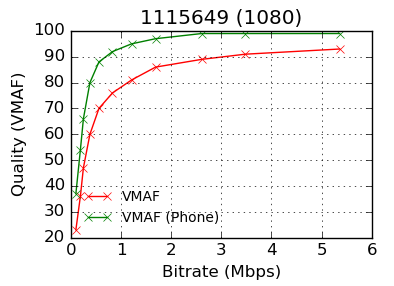
Because of screen size and viewing distance, the same distorted video is perceived as having a higher quality on a phone screen than on a laptop or TV screen. When the quality score reaches its maximum (100), further increasing the encoding bitrate does not result in any perceptual improvement in quality.
Predict Quality on a 4KTV Screen at 1.5H¶
A 4K VMAF model at model/vmaf_4k_v0.6.1.json predicts the subjective quality of video displayed on a 4KTV and viewed from the distance of 1.5 times the height of the display device (1.5H). This model is trained with subjective data collected in a lab experiment, using the ACR methodology (it uses the original 5-level discrete scale instead of the continuous scale). The viewing distance of 1.5H is the critical distance for a human subject to appreciate the quality of 4K content (see recommendation). More details are in this slide deck.
To invoke this model, specify the model path on the vmaf CLI:
vmaf --reference ref_path --distorted dis_path \
     --width 3840 --height 2160 --pixel_format 420 --bitdepth 8 \
     --model path=model/vmaf_4k_v0.6.1.json
Or from the Python scripts:
python -m vmaf.script.run_vmaf yuv420p 3840 2160 \
    ref_path dis_path \
    --model model/vmaf_4k_v0.6.1.json
Disabling Enhancement Gain (NEG mode)¶
For comparing encoders, VMAF offers a special mode, called No Enhancement Gain. This is described in the following blog post:
One unique feature about VMAF that differentiates it from traditional metrics such as PSNR and SSIM is that VMAF can capture the visual gain from image enhancement operations, which aim to improve the subjective quality perceived by viewers. (…) However, in codec evaluation, it is often desirable to measure the gain achievable from compression without taking into account the gain from image enhancement during pre-processing.
To disable enhancement gain, use the versions of the model files ending with neg (vmaf_v0.6.1neg, vmaf_4k_v0.6.1neg); see VMAF NEG.
More details on the reasoning behind NEG have been shared in this tech memo. A high-level overview can be found in this slide deck.
What are the Differences between Individual Models?¶
There are no material differences between 0.6.1, 0.6.2 and 0.6.3. The latter two were retrained later on the same dataset with the same hyperparameters, but using elementary features that were slightly improved.
The 0.6.2 and 0.6.3 models also come in _b (bootstrap) variants, which enable prediction confidence intervals. See the confidence interval document.
Each model also has a corresponding _float_ variant (for example vmaf_float_v0.6.1.pkl / vmaf_float_v0.6.1.json), which evaluates features in double-precision floating-point instead of the default fixed-point path. The fixed-point path is bit-exactly reproducible; the floating-point path is the one the tuning experiments were run against.
GPU and SIMD acceleration (fork-specific)¶
All models above run on every backend of the fork. GPU backends are enabled at build time (-Denable_cuda=true, -Denable_sycl=true, -Denable_hip=true, Metal on Apple Silicon) and auto-selected at runtime; opt out per invocation with --no_cuda, --no_sycl, --no_hip or --no_metal, or select one with --backend. A feature without a twin on the active backend runs on the CPU.
| Backend | Models supported | Exactness vs CPU |
|---|---|---|
| CPU (scalar, AVX2, AVX-512, NEON) | All | Reference. The scalar fixed-point path is the archival reference the three Netflix golden-data checkpoints assert against (see principles.md §3.1). |
| CUDA, SYCL, HIP | All | Per feature: most twins are declared bit-exact, the others are held to a tolerance (generated twin table). |
| Metal | All | Held to a tolerance (places=4); see backends. |
Fork-added per-backend snapshot tests catch regressions within those bounds. For backend setup and selection, see backends/index.md.
Tiny-AI models (fork-specific)¶
The fork also ships small ONNX Runtime models under model/tiny/ for the tiny-AI surface documented in docs/ai/. These are not replacements for the Netflix SVM models above; they are opt-in augmentations and companion extractors for full-reference regressors, no-reference heads, saliency maps, shot boundaries, perceptual-distance features, and learned pre-filters.
The registry at model/tiny/registry.json is the source of truth for shipped tiny-AI artefacts. Production entries include:
| Family | Examples | Use |
|---|---|---|
| VMAF-tiny FR regressors | vmaf_tiny_v2, vmaf_tiny_v3, vmaf_tiny_v4, fr_regressor_v1, fr_regressor_v2, fr_regressor_v3 | Estimate teacher VMAF from compact feature vectors; v2/v3/v4 are the progressive tiny VMAF ladder. |
| Probabilistic / codec-aware FR | fr_regressor_v2_ensemble_v1_seed0..4 | Ensemble members for uncertainty-aware vmaf-tune decisions. |
| Perceptual features | lpips_sq_v1 | Full-reference LPIPS-SqueezeNet perceptual distance. |
| No-reference / saliency | nr_metric_v1, saliency_student_v1, saliency_student_v2, transnet_v2 | NR quality, saliency maps, and shot-boundary detection. |
| Learned filters | learned_filter_v1, fastdvdnet_pre | Pre-filter / denoising surfaces used before scoring or encoding. |
Smoke-only entries such as smoke_v0, smoke_fp16_v0, and historical placeholder rows remain in the registry for CI and compatibility; check the row's smoke flag and the per-model card before treating an entry as production.
Use a tiny model through the vmaf CLI with --tiny-model:
vmaf --reference ref.y4m --distorted dis.y4m \
     --tiny-model model/tiny/vmaf_tiny_v2.onnx \
     --tiny-device auto
For runtime details, see tiny-AI inference. For the registry schema, signatures, and model identity checks, see model-registry.md. For path, size, operator, and signature hardening, see security.md.
Rust prediction (experimental)¶
A build with -Denable_rust_features=true can run the prediction step of the vmaf_v1.0.16* models in Rust instead of C. Select it per process with the environment variable (unset or c keeps the C predictor, the default):
VMAF_FEATURE_IMPL=rust vmaf --reference ref.yuv --distorted dis.yuv \
     --width 576 --height 324 --pixel_format 420 --bitdepth 8 \
     --model version=vmaf_v1.0.16_3d0h --precision max
What moves to Rust: feature normalisation, the chroma correction of the v1 models, the nu-SVR evaluation (RBF kernel, plus the linear and polynomial kernels), denormalisation, the finite check, the polynomial and piecewise-linear score transform and the clip. Model loading, the feature extractors and the pooling stay as they are. The Rust predictor returns the C predictor's score bit for bit; scripts/ci/rust_twin_diff.py --models runs both and fails on any difference at --precision max.
Log lines say which predictor ran: an INFO line model <name>: Rust prediction names every model that runs in Rust. A model the Rust predictor does not implement (a classification SVM, a precomputed or sigmoid kernel) runs on the C predictor with a WARNING that names the model and ends in running the C predictor; so does every model when the build has no Rust predictor (-Denable_rust_features=false). A value of VMAF_FEATURE_IMPL other than c or rust is an error. The design is in Rust extractor framework.