Upstream parity guard
Code this fork inherited from Netflix/vmaf returns what Netflix's source returns. A difference is allowed only when an ADR records why the fork differs, and each one is listed with its measured size (ADR-1487). The upstream parity guard checks this: it builds Netflix/vmaf and this tree in the dev container image, runs both through the C API and compares every value they emit, bit for bit.
make upstream-parity        # probe set: about two minutes from nothing
make upstream-parity-full   # every fixture, option variant and model, twice: about ten
Both targets need the dev image (vmaf-dev-mcp:local, built by docker compose -f dev/docker-compose.yml build dev-mcp, see the dev container guide); UPSTREAM_PARITY_IMAGE names another one.
upstream parity: PASS means every value both trees emit is identical or covered by a recorded deviation, and every recorded deviation still exists. Run the probe set before pushing a change to an inherited extractor (core/src/feature/ files that Netflix has too, the picture and pooling code of core/src/), and the full matrix when the recorded upstream head moves.
What is compared
| Upstream side | This tree | |
|---|---|---|
| Source | Netflix/vmaf at the recorded parity head: the heading "Upstream head the fork is at parity with" in known upstream bugs, read by scripts/ci/upstream_parity_pin.py | the checkout the guard runs in |
| Build | meson setup of libvmaf/, release, enable_float, CPU only, with the compilers of this tree's golden build | the golden build profile, scripts/ci/setup-golden-build.sh (ADR-1317), in the guard's work directory |
| Environment | the dev container image, for both builds and every run (below) | the same image |
| Program | scripts/dev/upstream_parity_harness.c, linked statically against that tree's libvmaf.a | the same source |
The harness
The harness makes one request through the C API (vmaf_use_feature() or a model load, vmaf_read_pictures(), the flush) with one worker thread, and prints everything the feature collector holds at %.17g: each per-frame value, each aggregate, and the mean and harmonic-mean pool of each metric. Neither tree's vmaf tool can serve: upstream's prints six decimals.
Request set
The requests come from scripts/dev/upstream_parity_matrix.py:
- Extractors: the 16 both trees register:
adm,vif,motion,float_adm,float_vif,float_motion,float_ssim,float_ms_ssim,float_psnr,float_moment,psnr,psnr_hvs,ciede,cambi,speed_chroma,speed_temporal; at their default options and at 169 option variants. - Models: the 24 model files upstream ships under
model/and four built-in versions, withtransformandnoclipfor two of them. - Dispatch:
scalar(cpumask63) anddefault(cpumask0); the full matrix addsavx2(cpumask48) on x86.
The probe set is every extractor at its defaults on 18 of the fixtures, the option variants on nflx8, cb1 and noise8, and seven models on the same three. The full matrix is every fixture, the option variants on five fixtures and every model on eight.
Fixtures
| Fixtures | Source | Needed |
|---|---|---|
nflx8, cb1, cb10 | the three Netflix golden pairs, scripts/test/fetch-test-yuvs.sh | yes |
noise8 to noise16, nflx422, nflx444, nflx400, nflx10w, nflx16w, odd444, s256x144 down to s8x8 | derived by the guard from the 576x324 pair: full-range noise (SHAKE-256), chroma repeated to 4:2:2 and 4:4:4, luma only, samples widened to 10 and 16 bits, top-left crops | no file needed |
nflx10, nflx12, nflx16, nflx422p10, sparks10, q160x90, akiyo352, akiyo18x22 | the other Netflix clips under python/test/resource/yuv | compared when present |
bbb4k | testdata/bbb (6 frames) | compared when present |
A fixture whose file is absent is listed as fixture not compared and its runs are not counted.
What counts as a difference
- Value: the two printed numbers differ. Equal text is equal; two NaNs are equal whatever their sign;
0against-0is a difference of size 0; a NaN or an infinity on one side is a difference of infinite size. - Status: the run ends differently.
ok(the request completed, with or without values),error(an API call failed, or the tree printed an error of its own) orcrash(a signal). Both sides failing the same way is not a difference. A crash of this tree's harness always fails the guard. - Name: a metric only one tree emits in a run both complete.
- Pooled values follow from the per-frame values. Where those differ, the pooled difference is counted as derived and not bounded. Where the frames are identical, a pooled difference is a difference in the pooling code and is treated like any value.
The pinned environment
Netflix's own values depend on the compiler and the C library they are built and run with. Its ciede2000() squares with powf(x, 2): in the dev image (GCC 15.2.0, glibc 2.43) that returns this tree's product on every frame the guard compares, while on a host with glibc 2.44 it differs on 119 of 327 frames by up to 2.2e-11 (fork PR #1892). A comparison is therefore evidence only in one recorded environment, and the guard has one: the dev container image.
--container [IMAGE](what both make targets pass) starts the guard in the image with no network, as the calling user, with the checkout mounted at its own path, and fetches the recorded head on the host first.- Both result documents record the environment: the image id, the compilers' versions, the C library and the machine. The report's first line names it. Two documents from different environments are not compared (exit 2).
- Outside the image the guard refuses to measure (exit 2).
--unpinnedmeasures anyway and marks the verdict(advisory: environment not pinned); such a result is not evidence of parity and does not move a bound. - Builds and the run cache are kept per environment under
build-upstream-parity/(image-<id>/,host/), so a host build is never reused in the image.
Undefined upstream values: the heap check
Some of upstream's outputs are read from memory it never wrote: the guard cannot bound a difference from a value that changes with what the heap held. --heap-check (what make upstream-parity-full passes) runs every request of both trees a second time with MALLOC_PERTURB_=170, which makes glibc fill fresh allocations, and compares each tree with itself:
- An output of this tree that changes fails the guard: it reads memory it did not write (the defect class of
T-FLOAT-SSIM-SUB-WINDOW-SIMD-COUNT-2026-10-02). - An upstream output that changes is undefined. A fragment may cover it, but only with
bound: inf; a finite bound over it fails the guard, because a later run with other heap contents would exceed it.
In the dev image 1,675 upstream outputs in 45 runs change with the heap fill: ciede on the odd-sized crops, float_motion with motion_add_scale1 and motion_add_uv, and float_adm and float_vif on the 12x9 and 8x8 crops. None of this tree's outputs does.
What is not compared
aarch64 and NEON; clang, icx and MSVC builds; any environment but the dev image; more than one thread; n_subsample; pooling methods other than mean and harmonic mean; float_ansnr (upstream only); the extractors and options only this tree has; the GPU twins, which the cross-backend gate holds to the CPU.
Running it
scripts/dev/upstream_parity.py --container                     # = make upstream-parity
scripts/dev/upstream_parity.py --container --mode full --heap-check   # = make upstream-parity-full
scripts/dev/upstream_parity.py --container --only F.ciede      # runs whose name contains the text
scripts/dev/upstream_parity.py --container --dispatch scalar
scripts/dev/upstream_parity.py --container --summary           # group what is not covered
scripts/dev/upstream_parity.py --container --write-json out/   # keep both result documents
scripts/dev/upstream_parity.py --from-json out/upstream.json out/fork.json
scripts/dev/upstream_parity.py --unpinned                      # on the host: advisory only
| Exit status | Meaning |
|---|---|
| 0 | parity holds |
| 1 | a difference is not covered or is above its bound, a fragment is stale, this tree's harness crashed, or (heap check) an output of this tree depends on the heap or a finite bound covers an undefined upstream value |
| 2 | the comparison could not be made: no recorded head, a required fixture missing, a failed fetch or build, a malformed fragment, outside the pinned environment without --unpinned, documents from two environments |
The guard fetches master of https://github.com/Netflix/vmaf.git into FETCH_HEAD (--no-fetch reuses the one present), exports the recorded commit, and builds under build-upstream-parity/ (ignored by git). Run results are cached there per harness binary, environment and heap fill, so a second run of an unchanged tree only compares. UPSTREAM_PARITY_JOBS (default 8) sets the workers of both builds and of the runs.
With --only or --dispatch the run set is a slice of the matrix. A slice cannot tell a stale fragment from one whose witness was not run, so stale fragments are reported there and do not fail.
The allowlist
One file per difference under scripts/ci/upstream_parity.d/, named <extractor>.<topic> (model.<topic> for predicted scores). The generated table is allowed differences from Netflix/vmaf.
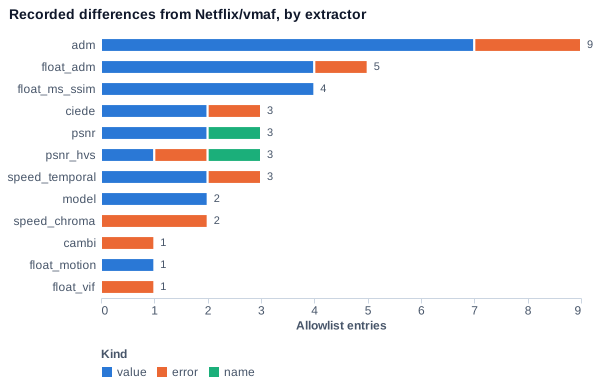
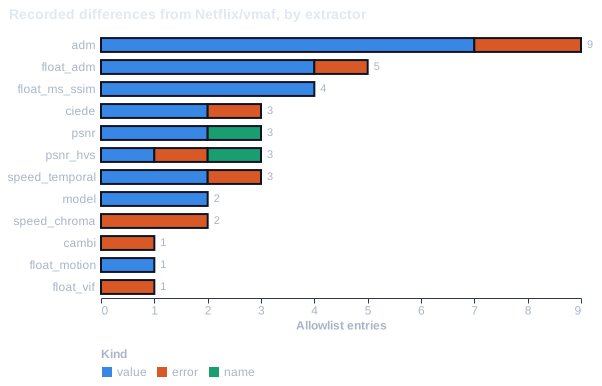
Source: the fragments in scripts/ci/upstream_parity.d/, one per recorded difference.
Data table
| Extractor | value | error | name | Total |
|---|---|---|---|---|
adm | 7 | 2 | 0 | 9 |
float_adm | 4 | 1 | 0 | 5 |
float_ms_ssim | 4 | 0 | 0 | 4 |
ciede | 2 | 1 | 0 | 3 |
psnr | 2 | 0 | 1 | 3 |
psnr_hvs | 1 | 1 | 1 | 3 |
speed_temporal | 2 | 1 | 0 | 3 |
model | 2 | 0 | 0 | 2 |
speed_chroma | 0 | 2 | 0 | 2 |
cambi | 0 | 1 | 0 | 1 |
float_motion | 1 | 0 | 0 | 1 |
float_vif | 0 | 1 | 0 | 1 |
Fragment keys
| Key | Meaning |
|---|---|
kind | value, error, name, pending-revert or pending-port |
runs | globs over the run name: F.<extractor>.<options>, M.<model>, C.<collection>, B.<built-in>. Default F.<extractor>.* from the file name |
metrics | globs over the metric name (value, name) |
fixtures | globs over the fixture name; default every fixture |
frames | globs over where the value sits: a frame number, agg, pool-mean, pool-harmonic; default all |
dispatch | scalar, avx2, default; default all |
bound | the largest absolute difference covered; inf covers a NaN or an infinity on one side, and is the only bound allowed where upstream's value is undefined (the heap check) |
status | <upstream>/<fork> pairs of ok, error, crash (error; also allowed on a value whose upstream side is undefined behaviour that sometimes ends the run instead) |
side | fork or upstream: the tree that emits the name (name) |
adr | the ADR(s) that record the deviation; required unless the fragment is pending |
upstream | Netflix/vmaf#<n>: the pull request or issue that would end the deviation. Optional: leave it out while none exists and add the line when one is opened |
branch | the branch that ends a pending difference |
evidence | one line: what was measured |
A difference is attributed to exactly one fragment that covers it: a deliberate fragment before a pending one, then the one with the smallest bound. A fragment to which no difference is attributed is stale and fails the guard. That is what ends a pending fragment: once its revert or port is on master, nothing is attributed to it any more.
Adding a deviation
- Write the ADR: upstream's behaviour (file and line at the recorded head), this tree's, why it differs, and what would end it. No ADR, no fragment.
- Measure in the image:
scripts/dev/upstream_parity.py --container --mode full --heap-check --summarylists what is not covered, grouped by run, metric and fixture, with the largest difference of each group. - Add the fragment. Scope it as narrowly as the deviation: the option that triggers it, the fixtures it shows on, the dispatch if it is a SIMD matter. The bound is the measured maximum, rounded up to two digits, or
infwhere the heap check finds upstream's value undefined. A bound is not a tolerance: it records how far the deviation reaches, and a larger difference later is a finding. Theevidenceline names the environment it was measured in. make docs-fragments-writeregenerates the table, andmake upstream-parity-fullmust pass with no stale fragment.
A fragment that should disappear (an unintended difference whose revert is in progress, an upstream change that is being ported) is pending-revert or pending-port with its branch. It needs no ADR. The pull request that lands the branch removes the fragment; if it does not, the guard fails as stale on master until someone does.
When the recorded upstream head moves
A port or sync changes the heading in known upstream bugs (id and date only; the licence provenance job reads the same heading). In the same pull request:
make upstream-parity-fullagainst the new head.- A difference that appears is either what the port brought in wrongly (fix the port) or something upstream changed that the port left out (a
pending-portfragment naming the branch that will port it, or the port itself). - A fragment that goes stale because upstream took the fork's fix is removed, and its ADR gets a superseding note in the port's ADR.
Where it runs
Locally, in the dev image. The guard is not a required check and no hosted job runs it yet (T-UPSTREAM-PARITY-GUARD-HOSTED-JOB-2026-10-02 in state.md): a hosted job would have to build or pull the same image, and its bounds are measured on one host so far. The maintainer's workstation runs the full matrix nightly:
make upstream-parity-full UPSTREAM_PARITY_JOBS=8 > upstream-parity.log 2>&1 || echo "upstream parity: exit $?"
Warning
A run that did not happen is not a pass. Read the log's last line (upstream parity: PASS or FAIL) or the exit status, never their absence.
The script's own tests need no build: scripts/ci/tests/test_upstream_parity_allowlist.py and scripts/dev/tests/test_upstream_parity.py (a pre-commit hook runs both).
The A/B bench
testdata/bench_upstream_ab.py (ADR-1228) times upstream against this tree. It builds upstream through the guard, at the recorded head unless --upstream-ref names another commit or tag, and takes its score verdict from the guard: the model vmaf_v0.6.1 on the bench's fixtures, every value at %.17g, against the allowlist. The pooled delta it prints beside the timing is informational. The bench times on the host, so its verdict there is marked advisory; run in the dev image it is the guard's.
Result on master
Note
This section is a dated measurement, not a standing claim. It goes stale at the next upstream head move; re-measure with make upstream-parity-full.
Full matrix: measured on 2026-10-03 in the rebuilt dev image (sha256:14db4c43070a, GCC 15.2.0, glibc 2.43) on ryzen-4090-arc (Ryzen 9 9950X3D): master f65dc6969 against Netflix 9e48141b, after every revert and port landed. The allowlist holds 37 fragments, all deliberate deviations; none is pending. Every bound measured in the previous image (sha256:43ef1e32cb32) held unchanged in this one. Probe set: master 623b11ce2 in the previous image, before the SpEED revert and the five-frame motion port landed.
| Probe set | Full matrix | |
|---|---|---|
| Runs per tree | 1,848 | 5,349 |
| Runs both trees complete / both fail / end differently | 1,734 / 18 / 96 | 4,962 / 93 / 294 |
| Values compared | 254,922 | 911,802 |
| Identical | 221,936 | 820,800 |
| Pooled values that follow a per-frame difference | 6,590 | 20,512 |
| Differences covered by a deliberate fragment | 19,958 | 70,820 |
| Differences covered by a pending fragment | 6,550 | 0 |
| Not covered / above the bound / stale fragments | 0 / 0 / 0 | 0 / 0 / 0 |
| Heap check: upstream outputs that change / this tree's | not run | 1,675 in 45 runs / 0 |
| Verdict | PASS | PASS |
Changes since the probe-set run
What changed on master since the probe-set run:
- The integer ADM,
ciede,float_admandpsnr_hvsreverts are on master (fork PRs #1891, #1892, #1894, #1895), and so is the five-frame motion port (#1887): their fragments are gone. - The port is exact: the four
vmaf_v1.0.16_hfrmodels andmotion_five_frame_windownow run on both trees (114 more runs complete), and no difference they add is outside the allowlist. - With the last revert, SpEED, applied in a scratch copy of the tree before the port landed, the full matrix in the same image had 795,000 identical values of 886,002, no difference outside the allowlist and none above a bound, and exactly the 3
pending-revertfragments of that branch reported as stale. That is the state master reaches when it lands and its fragments are removed.
What no fragment covers
No fragment covers a value of cambi, vif, float_vif, motion, float_psnr, float_moment, float_ssim or psnr_y: wherever both trees return one, it is the same bit pattern, and so are prediction and the pooling of finite values. Since the reverts, the same holds for ciede outside 4:2:2 input and odd sizes, and for every per-frame value of psnr_hvs.
Three bounds are inf because upstream's value is undefined there: ciede.odd-size-chroma (upstream reads past its rounded-down chroma planes), float_motion.scale1-stride and speed_temporal.prescale-above-one. On the host, before the heap check existed, filling the heap moved the first two above the finite bounds they had then (0.3 and 26).
Run time
Time on that host, eight workers, with other builds running: from an empty work directory the probe set took 129 s in all, the export, both builds and the fixtures included (108 s of runs); the full matrix with the heap check took 565 s of runs for both trees twice. A second run of an unchanged tree takes seconds.